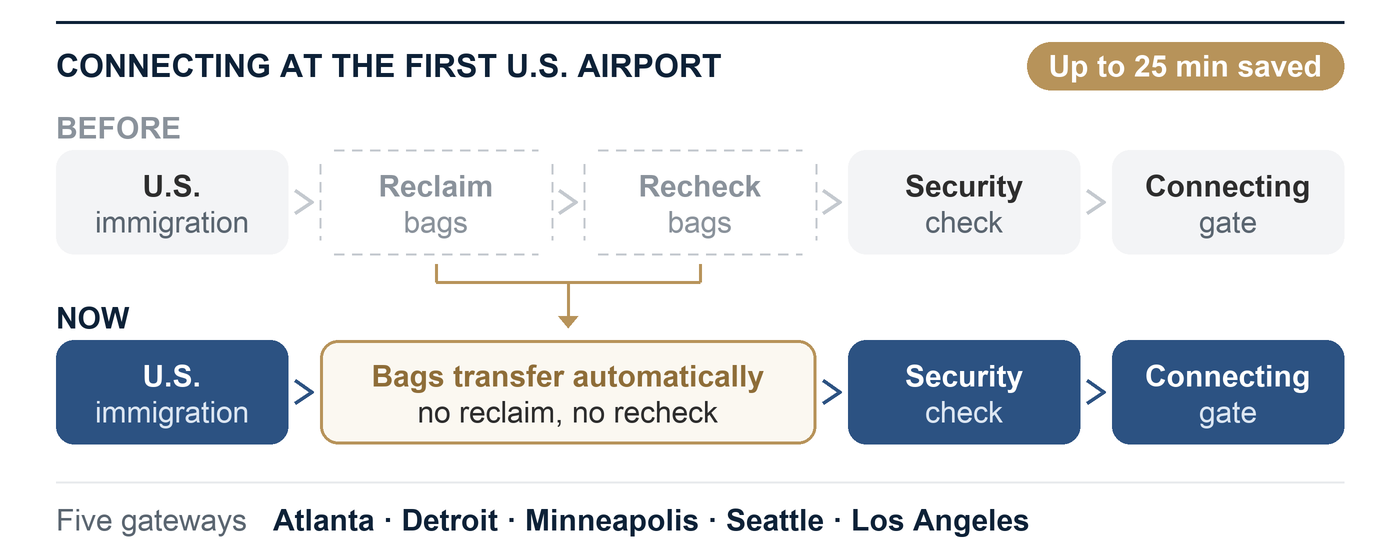
Passengers connecting from Incheon onto Delta Air Lines and Korean Air services through five U.S. airports can now have checked bags transferred automatically, avoiding the usual reclaim-and-recheck step. The airports are Atlanta, Detroit, Minneapolis, Seattle and Los Angeles. Delta Asia-Pacific vice-president Jeff Moomaw said at a Seoul media roundtable on November 25 that the service can reduce U.S. connection times by up to 25 minutes. Passengers still clear U.S. immigration and security before proceeding to their connecting gates.
The service uses International Remote Baggage Screening (IRBS). X-ray images of checked bags screened at Incheon are sent to U.S. authorities, who can review them while the aircraft crosses the Pacific. The bags are then transferred to the onward flight and collected at the passenger's final destination. This removes the need to collect luggage at the first U.S. airport and check it in again, although it does not remove immigration or passenger security procedures.
The programme was developed with Korean Air, Delta, IIAC, South Korea's Ministry of Land, Infrastructure and Transport, the U.S. Transportation Security Administration and U.S. Customs and Border Protection. The work took about five years. Incheon became the third airport worldwide, after Sydney and London Heathrow, to adopt remote baggage screening, and the first to build a fully automated IRBS system. For Delta, Incheon-originating routes are the first in the Asia-Pacific region to offer the automated transfer service.
The airlines are also pursuing One-Stop Security, a separate proposal that would allow eligible passengers arriving from Incheon to avoid a second security screening when transferring in the United States. The baggage arrangement concerns screening checked luggage remotely; it does not itself grant an exemption from passenger screening. Moomaw said the passenger-screening proposal was still being coordinated with the relevant authorities, and no implementation date had been set.